Quantum Chess Remastered 1.0
The Alchemy League, a phase dial, and badges
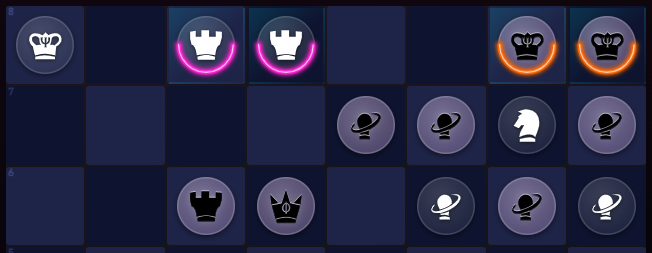
Quantum Chess hit 1.0 today. It’s live at chess.quantumnative.io, free to play. The remaster soft-launched in May and has been under continuous development since. Sound, replays, in-game guides, puzzle packs, correspondence, keyboard-only play, a proper mobile pass. Premoves work now. The AI stopped resigning when it should keep playing. Your online opponent has a name instead of “Opponent”.
But there’s one thing I’ve wanted to build since Quantum Chess first launched: a way to experiment with different rules. That ships today, as the Alchemy League.
Why a league
Quantum Chess’s ruleset is one point in a huge design space. Which quantum operations belong in the game, what legality conditions are right, what the most popular ruleset is… These are questions I’ve always wanted to answer. But it is hard to change the rules once a game is in the wild. The Alchemy League opens the door to experimentation, without changing the core experience players are used to. It’s a seasonal online ladder where every season changes the rules, everyone starts from a fresh rating, and by season’s end we know something about the variant that we didn’t before.
Season 1 makes two changes. Merge moves are gone. And next to the board there’s a dial.
The phase dial
The dial has four positions: 0, π/2, π, 3π/2. Set it before a move and the move carries that phase rotation.
Phase is the part of a quantum state you can’t see. When you split a queen, she is on two squares at once, and each square holds an amplitude. Probability only cares about an amplitude’s length. Rotate one and nothing observable changes: a phased move on a fully classical piece does exactly nothing, because a global phase is invisible. The dial matters where amplitudes meet.
So make them meet. Split your queen, and later split one of her halves again, aiming a branch at the square her other half occupies. Two amplitudes for the same queen arrive on the same square and have to add. The dial lets you mess with how they add. In the simplest case, the split with the interference played immediately after, the outcomes are exact: at rest the halves add to a coin flip, 50/50 between the two squares. One click and the queen lands on the new square with certainty. Three clicks and she comes back together on the other. This isn’t a recipe, though. Other moves can change the phase or entanglement between pieces. To master the effect, you’ll need to learn to read the phase and entanglement overlays on the board.
The dial turns a coin flip into a choice. And because Season 1 has no merge moves, this is also the only way to make a split piece whole again: the move that reunites your queen is another split.
The four phase dial settings are named for the stages of the Great Work: nigredo at rest, then albedo, citrinitas, rubedo. The league is called Alchemy because that’s what the dial does. You transmute probability into certainty.
Season 1
The season runs October 1 to January 1. League play is free for anyone with an account, live or by correspondence, on its own rating ladder that resets each season. The queue is open today for unrated games under the season rules, and there’s a pass-and-play practice board if you’d rather learn the dial without an audience. Everyone who plays rated league games earns the Alchemy board theme, aged brass over charcoal, when the season ends.
Badges
1.0 also ships badges: emblems you wear beside your name in matches, on the leaderboards, and on your profile. Click any badge you see, anywhere, to view it full size and wear it yourself.
The league has its own ladder of them, alchemical names throughout. Nigredo for playing, Albedo and Citrinitas for wins. Once the community plays 500 rated league games in a season, everyone who took part earns Prima Materia and the rank badges go live, eight of them from Vitriol at top 100 up to Magnum Opus for the season champion.
Standard play earns lifetime badges on three tracks: online games from Bell Pair to Einstein-Rosen Bridge at 500, games against the AI from Turing Test to Maxwell’s Demon for beating the Hard AI, and the leaderboards from Ground State up to Quantum Supremacy for holding #1. Leaderboard badges wait for a settled rating, so a lucky run on a fresh account can’t bank one.
Then there are feats: quantum moments the game notices. Copenhagen is a win by measuring the enemy king out of existence. Decoherence, the badge of shame, is measuring your own king to death. Most of the feats are hidden, and I’m not listing them here. Win streaks earn Coherence at 3, Phase Lock at 5, and Pure State at 10.
Every game you’ve already played counted. Badges you earned before badges existed should be waiting the next time you sign in. Some badges are free to wear, the rest come with premium, and anything you earn without it is banked, not lost.
On Steam, the whole set mirrors into achievements. Three of those were previously impossible to earn because the game never labeled collapse endings correctly; a measurement can finally decide a game and say so.
Premium
Everything above is playable free: online, ranked, the league, puzzles on a daily allowance. Premium is where the extras live. Subscribers get the full puzzle library, every official pack plus unlimited community puzzles. They also get unlimited correspondence games instead of one at a time, the Hard AI, analysis mode with the full quantum state at every ply, deeper engine evaluation, and the option to upload an engine of your own and play against it. Badges join that list. Premium wears everything you earn; free accounts can wear some of them.
Seasons feed it too. When an Alchemy season ends, its ruleset doesn’t vanish. Premium members keep access to ended seasons’ rules, so if the phase dial hooks you, January 1 isn’t goodbye.
A Steam copy is the full desktop game, with friend challenges through Steam’s own invite picker and six months of premium included. Link your Steam account in game to redeem it. On the web there’s a 7-day free trial if you want to look around first.
Come play
Quantum Chess 1.0 is at chess.quantumnative.io and on Steam. The league practice queue is open now, and Season 1 starts October 1. If you want to argue about phase dial openings before anyone knows what a phase dial opening is, the Discord is where that’s happening.
Nobody has ever been good at this variant. For about five weeks more, nobody is. See you on the ladder.
Comments