From Bloch Sphere to Bloch Rings
How quantum games push UI design
Most games show you everything that is happening on the screen. A chess board shows every piece, every square, the whole position. You might not know what your opponent is planning, but you know where everything is.
Quantum games can’t promise that. The state of a quantum game lives in a wavefunction, and a wavefunction holds a lot more than “this thing is here.” It has probabilities, sure. It also has phase, which you can’t observe directly, and entanglement, which isn’t a property of any one object at all. It lives in the relationships between them. All of it can change how the game plays out, and very little maps easily onto anything a player is already familiar with.
So a big part of making a quantum game is deciding what to show. Show too little and the player is guessing. Show too much and they’re reading a physics paper when they should be playing. I’ve been working on that problem for more than ten years now, and it is always fun when I find a solution that just feels good.
Quantum Chess and the spaghetti problem
When I started on Quantum Chess, I wanted the player to see everything. Pieces split into superposition, pieces get entangled with each other, and I didn’t know what a player would need to form strategy, so I just drew all of it. The early prototypes connected entangled pieces with ghostly lines.
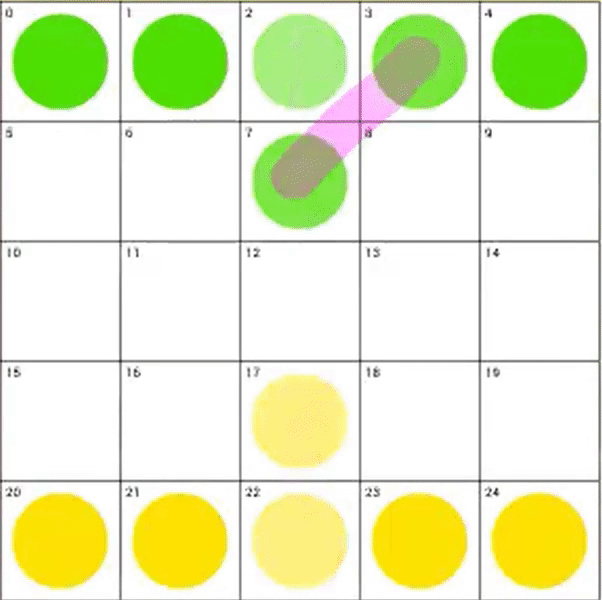
With two pieces, that’s great. You can see they’re linked. You can even encode information about that link in the color. But a real game doesn’t stay at two pieces. A few splits in, and every piece is connected to half the board, and the lines are crossing over each other in every direction. It looked like an old school game of Pick Up Sticks. Technically it was all there. Practically you couldn’t read any of it.
So I started taking things away. Over a lot of iteration passes, the display settled on one question per piece. How likely is it to be here? That became the radial display, a ring around each piece that fills up with its probability. A full ring is a piece that’s definitely there. A half ring is a coin flip.
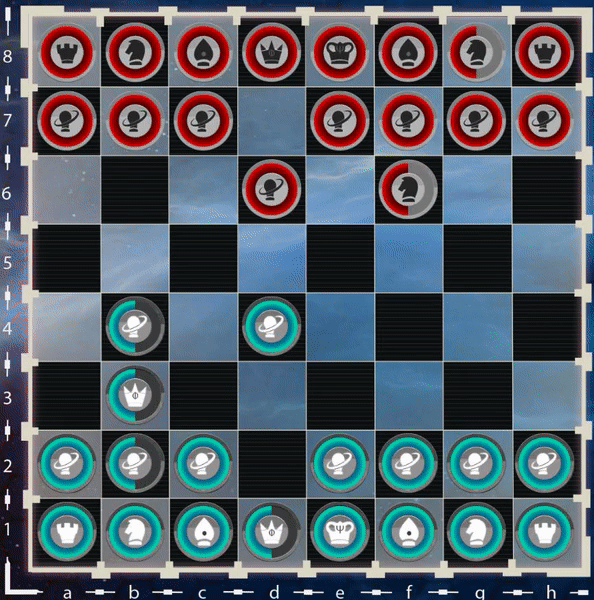
That worked, and it’s still the core of how the game looks. But probability isn’t the whole story, and sometimes you really do need the rest. So the last Unity version of the game added an “extra information display”. Right-click a piece and an overlay showed what it was entangled with and the relative phases that came with it.
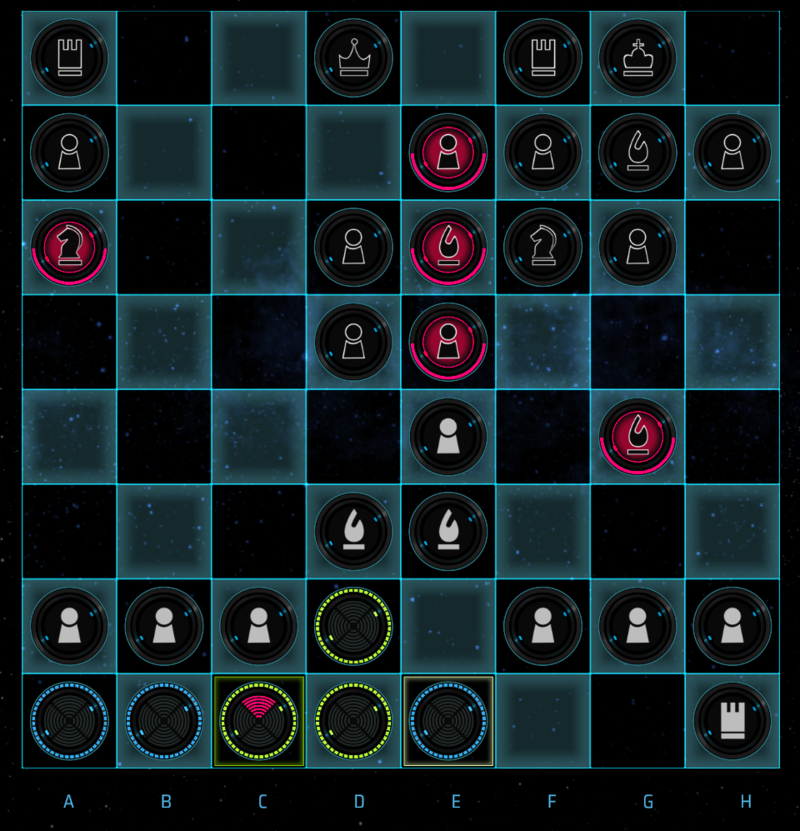
That was a real improvement. You only got the extra layer when you asked for it, and only for the piece you were thinking about. Even so, it was a lot to take in at once, and you had to know to look for it.
During the summer rebuild I simplified it again. Entanglement and phase show up automatically when you hover or select a piece. Phase went down to a single small diamond that sits on a piece’s ring. Entanglement now shows either as rings on the pieces it’s correlated with or as lines between them. No right-click, no separate mode. Look at a piece and the board tells you what it’s connected to. Look away and it gets out of your way.
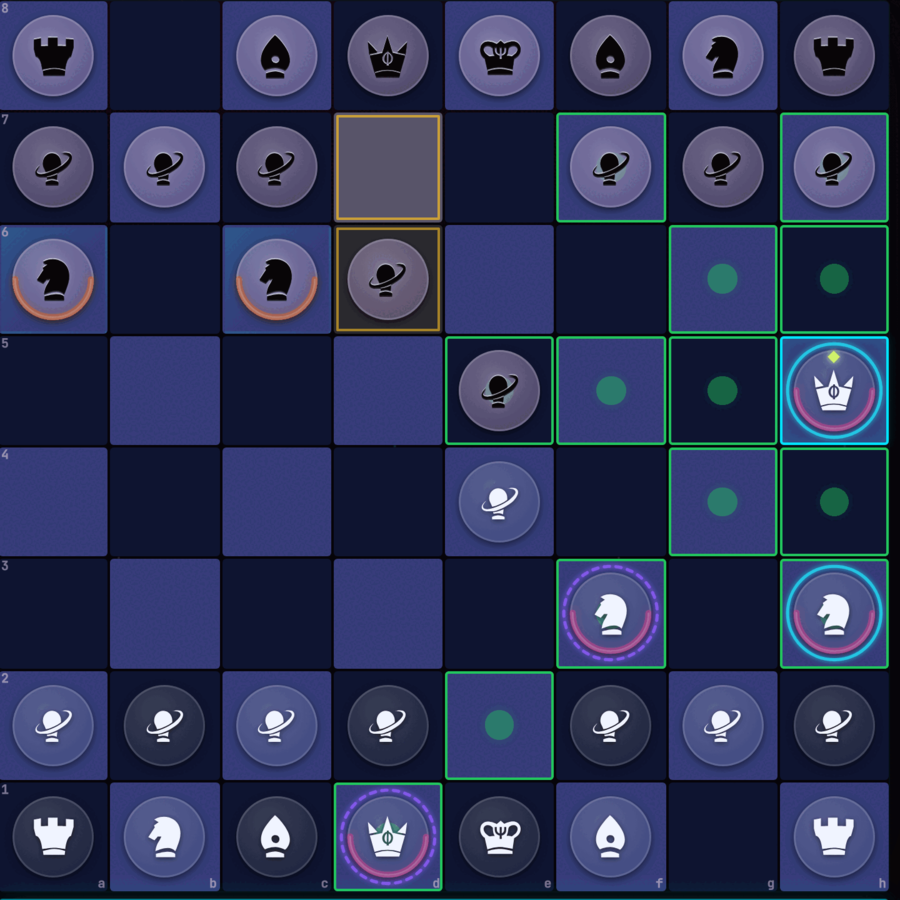
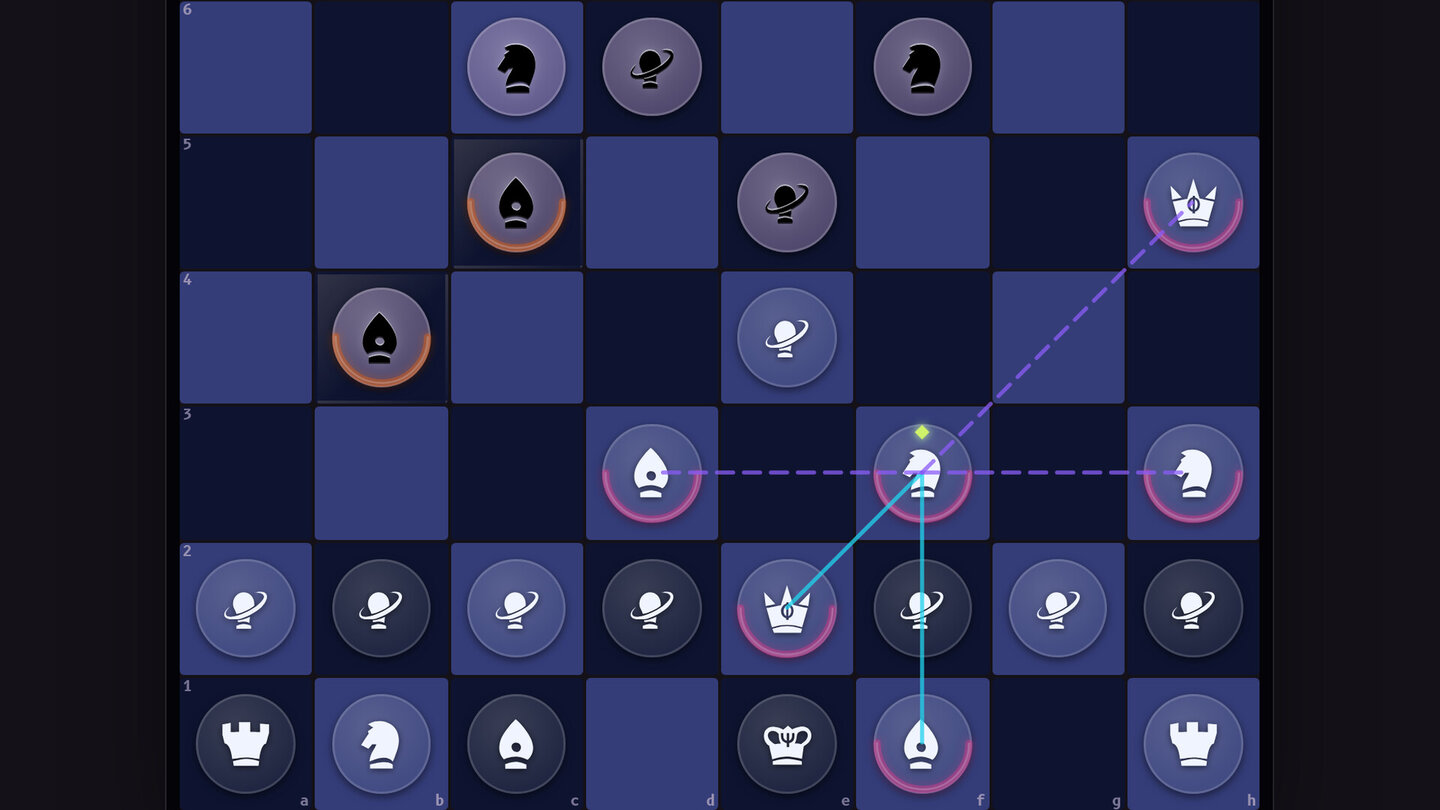
The lesson learned is that simplicity matters more than completeness. A player doesn’t need the whole wavefunction. They need the piece they’re thinking about, right now, and they need it fast. But it takes play testing to discover exactly what information will be useful to players.
Bloch Invaders and the Bloch Drive
When I started on Bloch Invaders, I had a different kind of game on my hands. Chess gives you all the time you want to stare at the board. A shooter gives you none.
The core idea is the Bloch Drive. Your ship carries a qubit, and the drive lets you rotate it. The invaders carry qubits too. When your shot hits an invader, the damage depends on how much your quantum state overlaps with theirs. Match their state and your shots tear through them. Point your state the opposite way and the invaders disappear into a parallel reality. So the game is a shooter where aiming happens in two places at once, where your ship is on the screen and where your qubit sits in its state space.
To show the player their qubit, I did the obvious thing and put a Bloch sphere in the HUD.
A quick tour of the Bloch sphere
If you’ve taken a quantum computing class, you’ve seen this picture. If not, here’s the short version.
A single qubit is a combination of two basis states, |0⟩ and |1⟩, each with a complex amplitude. The amplitudes are normalized, and a global phase can’t be measured, so it doesn’t count. What’s left is two angles that pick a point on the surface of the sphere.
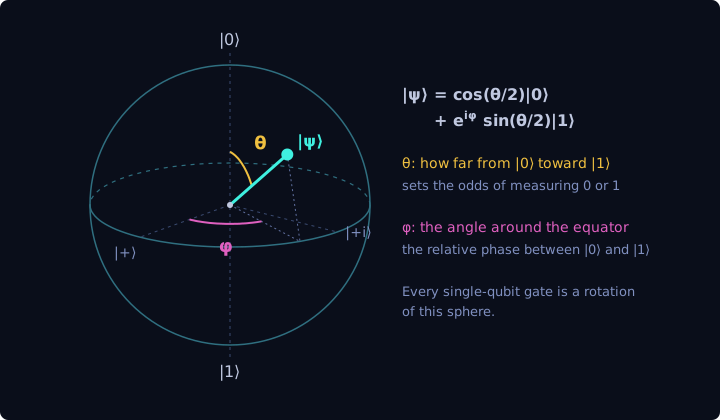
The polar angle, θ, says how far the state has tipped from |0⟩ at the north pole toward |1⟩ at the south pole. That sets the odds when you measure. Straight up always measures 0, straight down always measures 1, and anywhere on the equator is a coin flip. The azimuthal angle, φ, says where you are around the equator. That’s the relative phase between |0⟩ and |1⟩, the part that decides how the state interferes.
The sphere is named after Felix Bloch, who used it in his 1946 work on nuclear induction to describe how a spin’s magnetization precesses in a magnetic field. The idea is older than that, though. Henri Poincaré drew the same sphere for light polarization in 1892. In 1957, Feynman, Vernon and Hellwarth showed that any two-level quantum system can be pictured this way. Since then it has become the standard way to draw a qubit.
It’s everywhere because it makes the abstract stuff geometric. Every single-qubit gate is a rotation of the sphere. An X gate is a half turn around the x-axis. A phase gate spins the state around the vertical axis. States that can be told apart perfectly sit at opposite ends of the sphere. You can watch a computation happen as an arrow turning around a ball.
For a game about rotating a qubit, it seemed perfect.
Where are the invaders?
Here’s what the first HUD looked like. The sphere sat in the corner, with an arrow for your state.
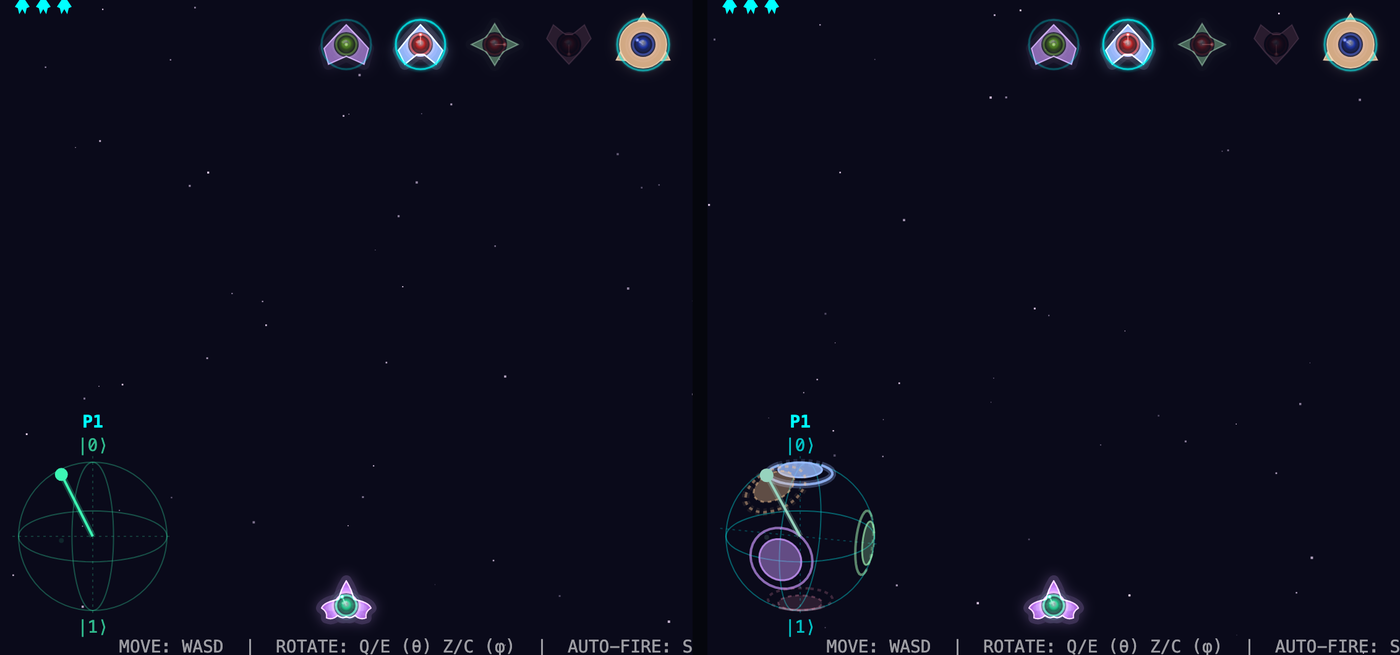
It told you where you were. It didn’t tell you where you needed to be. The invaders’ states were only hinted at by their color and design. It was confusing, especially while trying to dodge bullets.
So I put the invaders on the sphere. Each kind of invader got a target zone painted on the surface, as you can see on the right. Now the job was clear. Get your arrow into the zone.
That helped a lot. But it turned up the next problem. Knowing where the target is on a sphere doesn’t tell you how to get there. You have two controls, one for θ and one for φ. Which one first? Which direction? Is that zone in front of the sphere or behind it? A 3D sphere squashed into a 2D corner of the screen doesn’t make that obvious at a glance.
And again, the task was made harder by the need to dodge bullets. I noticed I was spending most of each wave staring at the sphere in the corner instead of at the invaders shooting at me. That’s a bad sign for a HUD. The instrument panel had become the game.
The Bloch Rings
I went back to the drawing board, wit Opus as my assistant. I asked it to produce 3 different concepts for what the HUD could be. They all missed the mark, but they did push me to start thinking in different directions. The sphere has two angles, and the controls turn one angle at a time. So why draw a sphere at all?
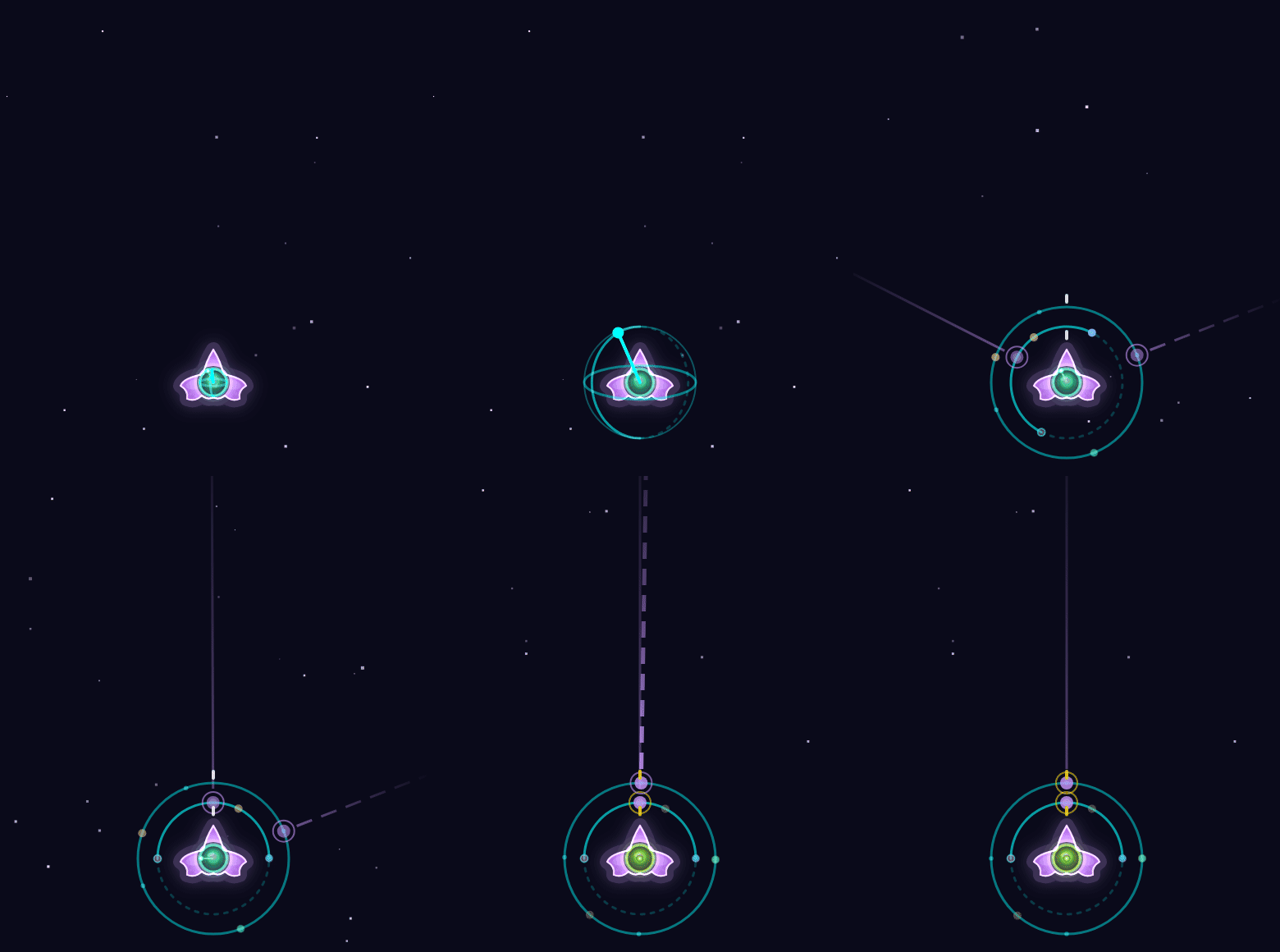
I pulled the sphere apart into its two angles and gave each one its own ring. The rings sit right around the ship, so they’re no drawing your eye away to some other part of the screen. The inner ring is θ, the outer ring is φ. Your own state is always at the top of both rings, pointing up the screen, directly along your line of fire. Every type of invader is then marked on each ring individually.
Matching an invader now means turning each ring until that invader’s marks come up to the top. When both marks are at the top, your state matches theirs, and you shots land with full damage (so do theirs). Rotate θ until one blip is forward, rotate φ until the other is forward, fire. This was a huge improvement. Quantum aiming now felt intuitive.
That’s what the animation at the top of this post shows, and what you see in game when the drive switches on. The Bloch sphere appears around the ship, its meridian swings face-on and becomes the θ ring, the equator tips up and grows into the φ ring, and the invaders’ marks come in last.
The decomposition has a couple of quirks. θ only runs from 0 to π, pole to pole, so only half of the inner ring is reachable. The other half is drawn dotted. And φ means nothing at the poles, since a state sitting exactly at |0⟩ has no phase to speak of, so an invader near a pole fades its φ mark out. I also added a small snap so lining up doesn’t take pixel-perfect accuracy.
It felt much better right away. I didn’t have to rebuild a 3D picture in my head anymore. I just had to bring two dots to the top.
Eyes up
It still wasn’t perfect. The rings are close to the ship, which beats the corner, but I was still watching the rings and not the invaders. Close to the action isn’t the same as in it.
So the newest addition throws the alignment out where your eyes actually are. The invader you’re lined up under puts a faint laser on each of its marks, pointing straight out from the center of the rings. The θ laser is solid and the φ laser is dashed. Turn a ring and its mark carries the laser around with it. When both marks reach the top, the two lasers merge into a single line up the firing column.
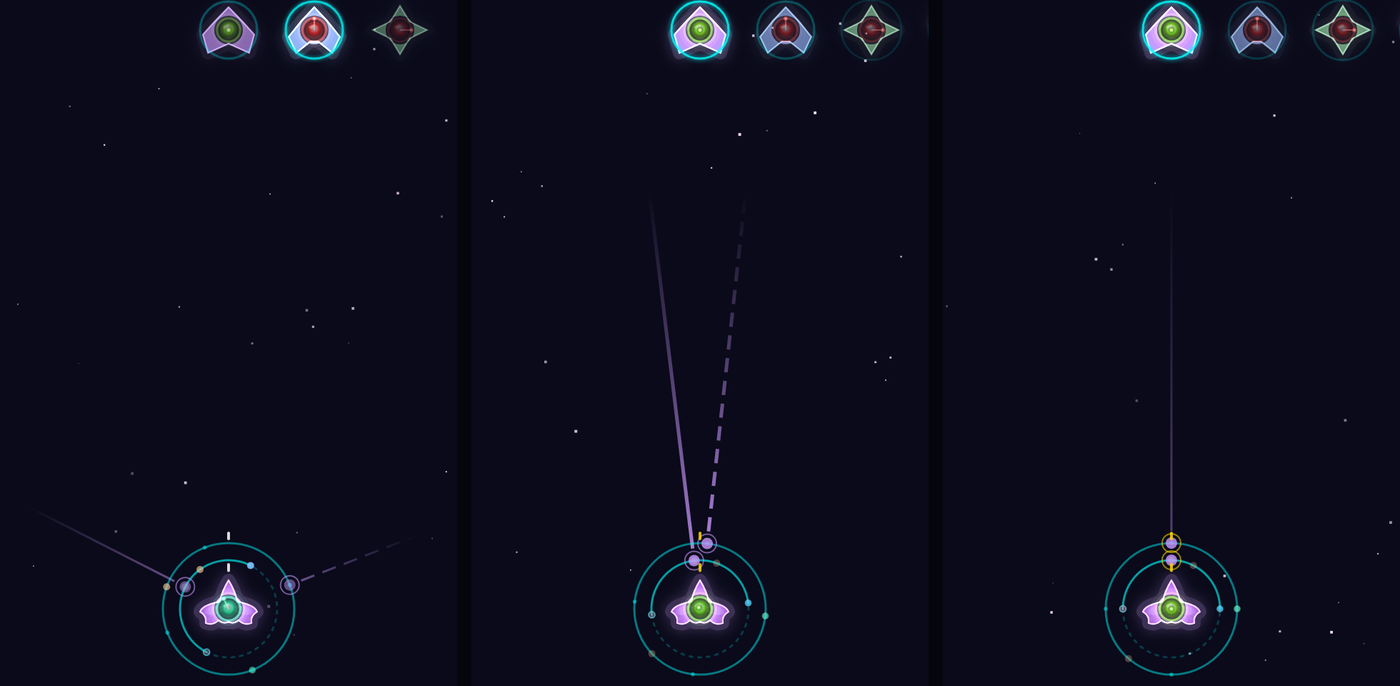
The idea is that a long faint line leaning off to one side is something you can catch in peripheral vision while you’re looking at the formation. You don’t need to read a dial. You just need to notice that the lines aren’t straight yet.
The laser sights are experiment. It might be the right answer, it might be too subtle, it might be too noisy once the screen fills up with bullets. That’s what player feedback is for, and I expect it to keep changing.
A picture that changed shape
What I like most about this whole thing is where it ended up. The Bloch sphere has been around for eighty years, and it’s how pretty much everyone learns to picture a qubit. It’s a great tool for thinking. It turned out to be a bad tool for a split-second decision in the middle of a firefight.
The physics underneath didn’t change at all. Same two angles, same rotations, same state. What changed was the question the picture had to answer. A textbook asks “what is this state?” A player asks “which way do I turn, right now?” Answering the second question pulled the sphere apart into rings around a spaceship, and I don’t think I’d have gotten there without a game forcing the issue.
If you want to try the rings, Bloch Invaders runs in your browser. And if you have opinions about the lasers, I really want to hear them. Come find me on Discord. Also, if you have ideas for how to modify this for the third boss, where entanglement starts coming into play, let me know. That’s the next experiment.
Comments